Title of the article: a prospective cohort study

Objectives State the main aim of the study and the major hypothesis tested or research question posed.
Design Give the study design, for example prospective cohort study.
Setting Describe the level of care (primary, secondary) and the number of participating centres; give the geographical location if important.
Participants Give the numbers entering and completing the study, with sex and ethnic group if appropriate, and how participants were selected.
Interventions Describe what, how, when, and for how long. Delete this heading if there were no interventions.
Main outcome measures List the outcomes planned in the protocol and those finally measured.
Results Report the main results with 95% confidence intervals (written as 15 to 27) and, where appropriate, absolute risks and the number needed to treat or harm.
Conclusions State the primary conclusions and their implications without going beyond the data.
Trial registration Give the registry and registration number (last line of the abstract).
Cohort Studies, Primary Health Care, Depression
What is already known on this topic
- Summarise the state of scientific knowledge on this topic before the study.
- Explain why this study needed to be done.
What this study adds
- Give a simple answer to “what do we now know as a result of this study that we did not know before?”, with the single most useful summary statistic.
Introduction
Keep the introduction to no more than three paragraphs on the background to the research question. Cite references in numerical order; the BMJ style shows them in square brackets [1]. Multiple citations are separated by commas or a range [2–4].
Methods
Write the manuscript according to the relevant reporting guideline, for example STROBE for observational studies [1], CONSORT for randomised trials [2], or PRISMA for systematic reviews [3], and upload the completed checklist as a supplemental file.
Study population
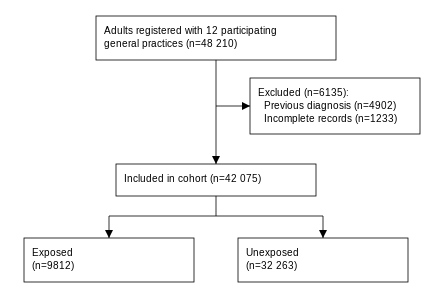
Describe the setting and participants. Figure 1 shows the flow of participants through the study.
Statistical analysis
Give the software and version used. Report data disaggregated by sex and gender, or explain why this was not possible.
Patient and public involvement
State whether and how patients and the public were involved in setting the research question, the outcome measures, the design and conduct of the study, and plans for dissemination. If they were not involved, say so here [5].
Results
Tables are kept in the main text where they are first cited, as in Table 1.
| Characteristic | Exposed (n=9812) | Unexposed (n=32 263) |
|---|---|---|
| Age (years), mean (SD) | 47.2 (12.1) | 48.9 (13.4) |
| Women, n (%) | 5104 (52.0) | 16 454 (51.0) |
| Current smoker, n (%) | 1374 (14.0) | 5807 (18.0) |
Discussion
The BMJ asks for a structured discussion of no more than a page and a half; subheadings are optional.
Principal findings
State the principal findings.
Strengths and limitations of this study
Discuss strengths and weaknesses of the study, and in relation to other studies.
Meaning of the study
Give possible explanations and implications for clinicians and policymakers.
Unanswered questions and future research
Describe unanswered questions and future research.
Acknowledgements: Acknowledge contributors who do not meet authorship criteria, and any prior presentation of this work at a conference (cite any published conference abstract).
Contributors: JD, JS, and AG conceived and designed the study. JS did the statistical analysis. JD wrote the first draft of the manuscript. All authors interpreted the data and critically revised the manuscript. JD is the guarantor. Describe any use of artificial intelligence tools here: name the tool, why it was used, and what task it performed. The corresponding author attests that all listed authors meet authorship criteria and that no others meeting the criteria have been omitted.
Funding: This study was funded by [funder, grant number]. The funder had no role in the study design; in the collection, analysis, and interpretation of data; in the writing of the report; or in the decision to submit the article for publication. All authors, external and internal, had full access to all of the data (including statistical reports and tables) in the study and can take responsibility for the integrity of the data and the accuracy of the data analysis.
Competing interests: All authors have completed the ICMJE uniform disclosure form at https://www.icmje.org/disclosure-of-interest/ and declare: no support from any organisation for the submitted work; no financial relationships with any organisations that might have an interest in the submitted work in the previous three years; no other relationships or activities that could appear to have influenced the submitted work.
Ethical approval: This study was approved by [name of ethics committee] (reference [number]). Participants gave informed consent before taking part.
Data sharing: [Describe where and how the data can be accessed, or state that data are available on reasonable request.] The analysis code is provided as a supplemental file and is available at [repository URL, commit ID].
Transparency: The lead author (the manuscript’s guarantor) affirms that the manuscript is an honest, accurate, and transparent account of the study being reported; that no important aspects of the study have been omitted; and that any discrepancies from the study as planned (and, if relevant, registered) have been explained.
Dissemination to participants and related patient and public communities: Describe when and how the results were (or will be) sent to participants and relevant patient and public communities, or explain why not.
Licence: The Corresponding Author has the right to grant on behalf of all authors and does grant on behalf of all authors, a worldwide licence to the Publishers and its licensees in perpetuity, in all forms, formats and media (whether known now or created in the future), to i) publish, reproduce, distribute, display and store the Contribution, ii) translate the Contribution into other languages, create adaptations, reprints, include within collections and create summaries, extracts and/or, abstracts of the Contribution, iii) create any other derivative work(s) based on the Contribution, iv) to exploit all subsidiary rights in the Contribution, v) the inclusion of electronic links from the Contribution to third party material where-ever it may be located; and, vi) licence any third party to do any or all of the above.